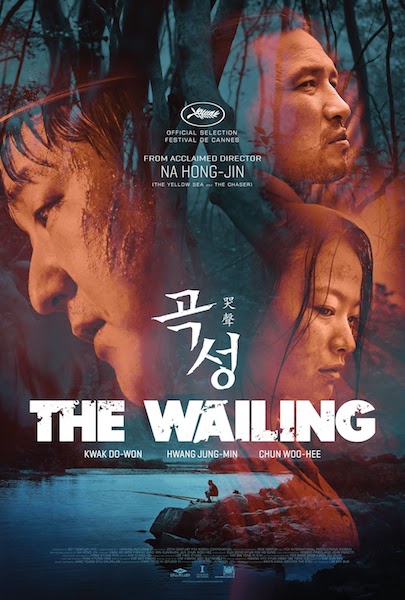
It all begins with the deaths. A growing pile of gruesome, supernaturally-tinged murders beset an otherwise quiet Korean suburb. Something is very wrong here. But rather than plunge us straight into the horror, writer-director Na Hong-jin guides us through The Wailing with an eye for fiddling with the genre conventions.
Our initial encounters with the dead and dying teeter on the edge of horrific, yet the scenes surprise us with their transitions to a gallows sense of humor. This humor is courtesy of Jong-gu (Kwak Do-won), a mostly inept and pathetic policeman tasked with solving the mystery. Rumors swirl that a mysterious Japanese man (Jun Kunimura), disparagingly named “the Jap” by his suspicious neighbors, is linked to these crimes. The humor endears us into a comfort with Jong-gu, his daughter Hyo-jin (Kim Hwan-hee), and the town’s loping pace of life. Director Hong-jin will supplant this wry sensibility with an increasing horror at the continuing plague of deaths.
A chilling investigation of the Japanese man’s residence connects an imminent curse to Hyo-jin. His daughter slowly displays the same calling cards that linked all the deaths—skin inflamed with boils, a loss of her usual self—and shifts into exhibiting signs of demonic possession. She curses with an evil flair, eats like a ravenous animal, and seems no longer the innocent little girl we knew before. In desperation, Jong-gu turns to a shaman (Hwang Jung-min) to exorcise the alleged demon. This fight for Hyo-jin’s very soul is tense, harrowing material. The bizarre rituals of the shaman battle with the Japanese man’s occult, violent curses. Jong-gu’s casually charming attitude turns into the fear of a father for his daughter’s life. This case, already disturbing enough, is now deeply personal, and cruel. Director Hong-jin mines the tension with careful cross-cutting and an increasing sense of dread.
Jong-gu doubles down on his pursuit of his only lead, the Japanese man, motivated by a toxic mixture of fear and anger that dovetail with the town’s casual racism against “the Jap.” Hong-jin introduces a difficult ambiguity in good and evil here, shifting the ground beneath our feet once again. Trust is rendered increasingly impossible as the shaman, the Japanese man and an enigmatic neighbor each suggest a different instigator for his daughter’s possession.
The search for a truth that can at once solve the murders and liberate his daughter’s soul seems frustratingly out of reach. It is arguable that at this point, at the film’s peak interest in diving into this creepy supernatural realm that governs Hyo-jin’s fate, the plot muddies into a less agile B-grade horror film. Hong-jin’s strong directorial control over the film’s tone mitigates this problem, but one does imagine a leaner editor’s cut that could better articulate this slide into unnerving murkiness.
Korean cinema that crosses stateside has been tackling genre cinema with an inventive, well-filmed and thoughtful sensibility for quite awhile now. Director Hong-jin, who made his mark off the serial-killer film The Chaser, continues this trend. The Wailing’s shifts from comedy to horror is a clever choice to disarm our defenses, then wrack us with the same paranoia that infects our policeman and father Jong-gu. It’s not so much the horror convention that scares you. Yes, there’s blood and bodies and jarring set-pieces. This is horror that gets under your skin as you dread the future well-being of the once-charming Jong-gu and his once-innocent daughter Hyo-jin.