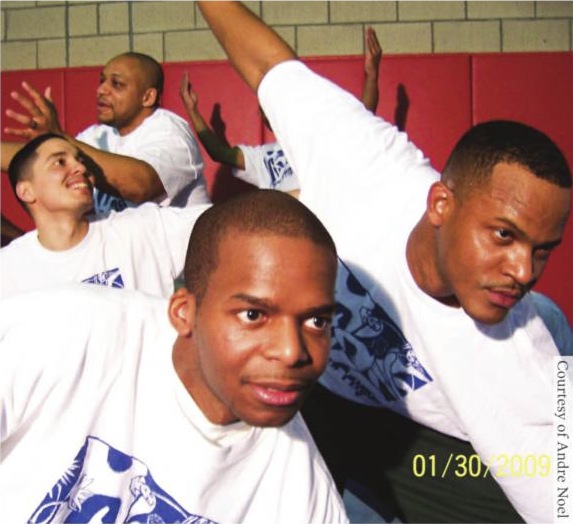
Andre Noel was imprisoned at 17 years old on burglary and assault charges. It wasn’t until he was incarcerated that he discovered modern dance. A friend invited Noel to watch a dance performance at the men’s prison, Woodbourne Correctional Facility.
“I wanted to support my friend, and as I was watching this performance there was this one particular piece of music,” Noel said. A woman, Susan Slotnick, ran a modern dance program at Woodbourne Correctional and choreographed the piece. Noel would join Slotnick, and began to learn to dance.
Now a free man for a year, Noel and other fellow free men from the prison and the program will perform in their newly formed company, Figures in Flight RELEASED, for an event entitled Dancing Freedom with Susan Slotnick: An Evening of Film and Live Dance on April 18 in the Frances Daly Fergusson Dance Theater in Kenyon Hall at 7 p.m.
Inside the lobby of the Fergusson will be oil paintings made by Susan Slotnick, about and based on the prison program she leads. The event itself will begin with a screening of a documentary film, A Reflection of Our Lives Through Dance, that chronicles the lives of the men in the dance program at Woodbourne Correctional Facility. A dance performance by Figures in Flight will follow, then the men will conduct a Q&A with the audience to conclude the event.
While at that pivotal modern dance performance with his friend, Noel saw a piece entitled “Each Other” about the criminal lifestyle. “It was a shock, where I saw my whole life being played out before me, with individuals doing the same things I have,” Noel said.
And Noel had an epiphany. “This is exactly where I want to be. I want to be a part of this. If these guys have the guts to represent themselves before fellows and prisoners, with all the heckling, for myself I felt that I should be a part of it too as well.”
Noel signed up for Slotnick’s Sunday modern dance classes. Beginning wasn’t easy; Noel noted that modern dancers typically begin their training early, and he was already 26 years old. “It felt awkward [at first]. I had a million butterflies flying all over my stomach. It’s because it was something new,” Noel said. “It’s exposing yourself for the first time … and I was never the type open to express myself in any way.”
But all his anxieties faded away once he finally began to perform. “Once I got into performance mode all the butterflies and everything flew out the window,” Noel explained. “I blanked out everybody else. I look beyond, as if I was dancing in space.” Noel went on to become the in-house director and choreographer for whenever Slotnick wasn’t at the prison; Slotnick only volunteered once a week.
“It was a moment in my life as well where I was going through a transition,” explained Noel. “I felt, soon, eventually I’m going to be out of prison and felt like I need to establish my life here before it’s too late…dance came at the right time.”
Noel’s instructor Slotnick began dancing as a child, but gave up the art at age 11. “But I always danced when I felt bad,” Slotnick said. “Dancing became an internal, private healing art for me.” Slotnick came back to dance in her 20s, and started teaching in the 1970s. She started to study dance further in New York City, especially learning about African-American dance forms, which intrigued her. Then the idea came to her.
“I danced myself when I felt like I was in prison as a kid,” Slotnick said. “I thought, ‘Where do people need to feel free?’ And a prison came to mind. I never had that much interest in the criminal justice system. Now I do. I just wanted to go someplace where people needed to feel free.” Slotnick began teaching prisoners, such as boys’ prisons, and took one of her programs to adult prisoners. It found its way to Noel.
Slotnick doesn’t feel she can take credit for having rehabilitated the prisoners. Many of the prisoners in her program are enrolled in Woodbourne Correctional Facility’s college program, and actively seeking to reform themselves, educate themselves and re-enter society upon release.
“The whole political system is in place to maintain the social contract and order in society. But real change doesn’t come from some- body telling you how you have to behave,” Slotnick explained. “Real change comes in the heart, and that’s what the arts can do—film, music, poetry, dance, theater. It can change people in their heart, and that change is permanent.”
Slotnick explained her philosophy for teaching dance. “I don’t teach dance, I teach people,” said Slotnick. “You teach people, and the conduit between you and the people is the material you’re actually teaching.”
“They’ve reformed me more than I’ve reformed them because of the quality of who they are,” added Slotnick. “I feel that the four men that are out that are going to perform at Vassar are extraordinary people—well-spoken, kind, grateful. More than any group of people I deal with on the outside.”
Lecturer in Dance and Drama Katherine Wildberger learned about Figures in Flight after her daughter visited the dance program. “When my daughter returned from the visit, she was so overwhelmed with all kinds of intense feelings and emotions. It was very powerful and took her some time to digest what she had experienced,” Wildberger wrote. “I had heard about Susan’s work with her young dancers as well as the prisoners, and was elated that she called me with an invitation to the Woodbourne Facility.”
Wildberger felt greatly touched by the performance she saw. “I questioned what I am doing as you do in the face of something very powerful,” Wilberger wrote. “I have been dancing all of my life and I thought I understood and recognized the heart of dance. It was upon viewing these men dancing, that I was witness to it.”
Noel doesn’t plan to stop dancing anytime soon. “What really helped me the most was that I discovered a passion for dancing,” Noel said. Noel said he has an outlet to articulate himself through dance, and tap into his emotions. “It opens up a new world for me.” Looking to the future, Noel now hopes to teach dance to at-risk youth in the city to help them, the same way dance helped—and helps—him. “It expands your horizons, which has worked quite well for a few of us,” Noel said.
Published via The Miscellany News